The American Federation of Teachers president explains why public schools helped reshape the 2026 midterms, what organized labor contributed, and what voters should expect from the next Congress.
Democrats' victories in Texas were among the biggest political surprises of the 2026 midterms. But according to American Federation of Teachers (AFT) President Randi Weingarten, the results weren't simply a rejection of President Donald Trump.
They also reflected growing frustration over public school funding, private school vouchers, data centers, and immigration enforcement.
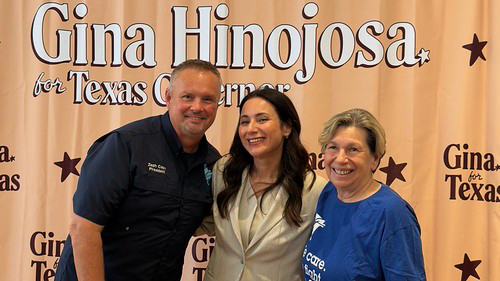
During our Monday morning conversation on We Decide: America at the Crossroads, Weingarten explained why she believes those issues helped Democrats James Talarico and Gina Hinojosa win in a state Republicans had controlled for decades.
And she had a warning for Democrats preparing to govern: Winning an election doesn't automatically mean voters trust you.
Weingarten identified several factors behind the Democratic victories, beginning with the candidates themselves.
Talarico began his career as a teacher in San Antonio. Hinojosa entered politics as a parent fighting the closure of her son's school.
Both brought personal experience with public education to their campaigns.
But Weingarten argued that it was Republican Governor Greg Abbott's education policies that also contributed to voter dissatisfaction, particularly in rural communities.
She pointed to the expansion of private school vouchers alongside public school funding pressures and tax incentives for data centers.
And according to Weingarten, those decisions created a powerful contrast for voters who watched their local schools struggle while large technology companies received government incentives.
"So kids were being hurt, and yet the governor was giving the data centers and big tech anything they wanted," she said.
Weingarten also identified immigration enforcement raids along the Texas border as another source of public frustration.
Her assessment was that the combination of education, data centers, and immigration enforcement helped create the conditions for Democrats' victories. However, that’s her interpretation of the election, not a conclusion established by voter data.
One of the more revealing parts of our conversation concerned the role public schools play outside major cities.
In many rural communities, schools are among the largest employers and serve as important gathering places.
Weingarten argued that Republicans underestimated how deeply residents value those institutions, regardless of political affiliation.
"The public schools tend to be the largest employer in a rural area," she explained. "Number two, they tend to be one of the only gathering places for community in a rural area."
That matters because debates over education funding aren't limited to classroom instruction.
When a school loses funding, closes, or cuts staff, the consequences can extend throughout the local economy.
Weingarten also argued that private school voucher programs can place additional pressure on public school budgets. She said some communities in other states have experienced rising property taxes as local governments attempt to compensate for reduced state support.
The broader question is whether lawmakers understand the economic and social role public schools play in the communities they represent.
The AFT was also deeply involved in the 2026 elections.
Weingarten described an organizing effort that extended well beyond traditional campaign endorsements.
The union worked with community organizations, participated in demonstrations, supported voter protection efforts, and mobilized members across 31 states.
"We had the biggest get out the vote operation we've ever done," she said.
In Texas, she estimated that the union made hundreds of thousands of phone calls, possibly approaching one million.
But Weingarten acknowledged that the complete voter data needed to evaluate the organizing effort's impact was not yet available.
That distinction matters.
The AFT can document its organizing activity. Determining how many votes that activity actually produced requires additional evidence.
Still, Weingarten believes the election demonstrated the potential influence of organized labor when unions work alongside communities on issues extending beyond wages and contracts.
Perhaps Weingarten's most significant assessment came when I asked what Democrats must deliver after their election victories.
I described the results as a mandate to strengthen public education.
She disagreed.
"Democrats were given a chance. They weren't given a mandate."
Weingarten, who said she left the Democratic National Committee a year earlier, argued that voters had rejected aspects of the Trump administration without necessarily developing renewed confidence in Democratic leadership.
"There was not a huge shift to trust Democrats, and Democrats have to prove themselves right now."
Her expectation is that congressional Democrats move quickly on legislation addressing affordability, healthcare, and public education.
She specifically wants lawmakers to challenge federal policies supporting private school vouchers, including the national education tax-credit program.
If Congress cannot repeal those provisions, she argued, Democrats should pursue measures to protect public school funding.
Her larger point was that electoral victories must translate into legislative action, even when the president is likely to veto proposed bills.
Our conversation also turned to technology in the classroom.
Weingarten described the AFT's "Devices Down, Hands On, Eyes Up" initiative, which calls for limiting screen use in early education and restricting student-facing artificial intelligence in elementary schools.
Her concern is that excessive reliance on technology can interfere with children's development of reading, writing, critical thinking, and interpersonal skills.
"We need to make sure we are really helping kids learn how to think," she said.
Weingarten also raised concerns about student data privacy and said the union has negotiated with technology companies, including Microsoft and Anthropic, to establish protections.
Those claims about privacy arrangements would require examination of the agreements themselves to determine their scope and enforceability.
For Weingarten, the election results represent an opportunity rather than a finished accomplishment.
She wants stronger public school funding, sufficient teachers, engaging curricula, after-school programs, and pathways to employment and affordable college.
But she also stressed that unions, parents, and community organizations cannot assume their work ends once candidates win.
"It's only a first step. The election is a direction. It's an inflection point."
The question now is whether newly elected officials can translate voters' frustrations into policies that improve their communities.
And for families concerned about public education, the next test won't be another campaign promise.
It will be what lawmakers actually do.
Also on This Week's We Decide: America at the Crossroads
We examined the political, military, and constitutional questions surrounding Defense Secretary Pete Hegseth, alongside the role public education played in reshaping Texas politics.
Hour One: Politics and Public Education
- A Block: What should congressional Democrats do about Pete Hegseth? Political analysis with Army veteran Laura Jedeed, journalist David Levinthal, and KPFT's Egberto Willies.
- B Block: Did public education help turn Texas blue? American Federation of Teachers President Randi Weingarten examines the election results and organized labor's role.
Hour Two: Military Leadership and Constitutional Accountability
- C Block: How has Hegseth changed the U.S. military? Former Marine captain Matthew Hoh and military law attorney James Branum discuss the consequences.
- D Block: What constitutional issues could shape a Hegseth impeachment? UMass Amherst legal scholar Dr. Jamie Rowen explains.
Jenna Flanagan hosts Pacifica Radio's nationally syndicated We Decide: America at the Crossroads, heard Mondays from 9 to 11 a.m. Eastern on WBAI 99.5 FM in New York City.