The Week That Was
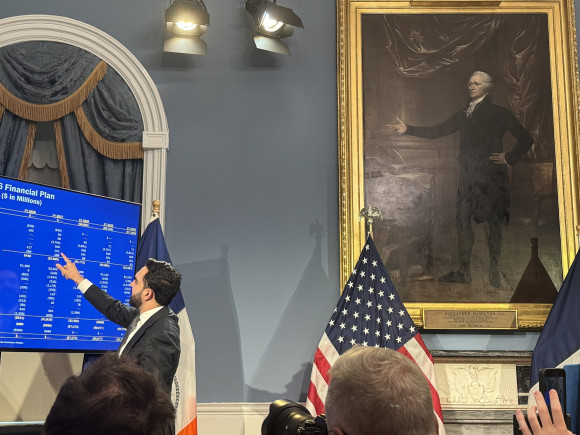
This past week Mayor Mamdani delivered a master class in how to completely reset the annual municipal budget conversation while delivering a $124.7 billion budget that on paper zeroed out a $12 billion budget gap looming in no small part due to cynical under budgeting by the previous Adams administration.
This bodes well for the rookie Mayor and the shrinking city that elected him. He pivoted gracefully from his preliminary plan that floated a property tax hike that was not well received by the homeowners of color who against all odds still own their own home in the face of racist redlining and outright rampant deed theft.
Yet, throughout the budget presentation, and the lengthy Q and A that followed, there was no reference to President Trump's evisceration of the social safety net more than one in four New Yorkers living in poverty rely on. There was no warning that the Trump anti-immigrant policies were helping to shrink New York City's population and that his war of choice with Iran was driving the world to the brink of a deep recession amidst an accelerating climate crisis.
There was no articulation of the existential threat from President Trump's ongoing assault on democracy, immigration and America's cities. There was no reference to the vast squandering of billions and billions of dollars on the military even as Trump cuts billions from domestic spending that are being felt in Mamdani's city.
As the nation sinks deeper and deeper into the role of global pariah with oligarchs consolidating their power, it seems ill advised to not speak to it when you are explaining the constraints of the City of New York's budget that is defined by the global economy.
It's a compartmentalizing that creates a kind of false sense of normalcy that matters are well in hand. And there's an echo effect in the news coverage of the Mamdani budget where the city's budget is framed provincially as something completely defined by Albany and New York City.
During the tenure of Mayor Adams, who had his own very personal reasons for not crossing Donald Trump, the sitting Mayor held back criticism of the White House no matter how outrageous its behavior targeting immigrants and higher education.
Now, New York City is shrinking. Shrinking cities are a formula for lower revenues, higher taxes, deteriorating services and outyear massive budget gaps. Cities have to grow to prosper. For years, with flatlining U.S. native birth rates it was immigration that powered New York City's rebound.
Back in the bad old days, when annual homicides topped 2,000 in New York City, hundreds of thousands of immigrants, documented and undocumented, moved into poor neighborhoods. They found hope and possibility where building owners were setting their buildings on fire for the insurance money.
It was this wave of foreign ambition rooted in work, family and faith that turned the city around with a homicide rate that's now a fraction of what it was. It wasn't Mayor Giuliani targeting the squeegee men or Mayor Bloomberg's massive Stop and Frisk---it was the immigrants that made New York City their home that made it more livable.
The Mamdani budget does set a new tone of collaboration with Albany and the City Council Speaker Julie Menin. This reset was not just rhetorical but manifested in billions of new support from Albany to support people centered priorities like universal childcare for two year-olds and the inclusion of City Council priorities like public libraries and parks.
Historically, these essentials for city life like library hours and park maintenance were reduced to bargaining chips the City Council would have to redeem by the end of June, the prescribed deadline for the city budget. This trail of bed crumbs approach undermined these institutions and made these noble workforces shamefully precarious.
There is a reliance on so-called one shots, the most controversial of which comes from leveling off payments due the city's pension over the next several years that will require the sign-off from the city's pension funds.
The left leaning, pro-labor Fiscal Policy Institute described it as "smoothing out a bizarre feature of the city’s pension payment schedule instituted in 2010, which had required accelerating payments through to fiscal year 2032, at which point the payments would turn negative and the pension funds would return money to the City over a seven-year period."
By contrast, the Citizens Budget Commission, which reflects a more fiscally conservative corporatist outlook, said the Mamdani budget closed "over half of the gap with short-term strategies, rather than a full-scale effort to shrink spending that doesn’t deliver for New Yorkers. A pension gimmick and temporary plugs exacerbate fiscal problems rather than solve them."
And the out year budget gaps widen going from $7 billion to fiscal year 2029 and $9 billion the next year.
Mamdani's budget team, led by Sherif Soliman, New York City Budget Director, and First Deputy Mayor Dean Fuleihan, along with a network of newly appointed Chief Savings Officers at every city agency, found over $3 billion dollars in savings and "systemic inefficiencies". This included having the city workforce handle projects now being done by outside contractors.
City Hall observers with longer tenures know the perils of this world of politically connected outsourcing.
There's no better example than the CityTime scandal that played out on Mayor Bloomberg's watch when the City of New York was bilked out of hundreds of millions by outside contractors who were supposed to be building a timekeeping system to prevent city employees from padding their hours. More recently, it's been contractors in business to help the homeless that help themselves more.
Sometimes fresh eyes looking at real cost containment can also yield a policy breakthrough.
Case in point, under the federal Individual with Disabilities Education Act the parents of special needs children can sue the City of New York for the cost of covering private school if the public school system fails to meet the required education needs of their child. In 2013 these due process payouts were $161 million but are expected to hit $1.5 billion this year.
Not only is the process expensive, it also becomes adversarial and the kids lose out. In child development weeks and months count. Delays and bureaucracy produce regression. This new alignment has at its core that every kid counts and time is of the essence.
"For decades in this city, special education students and their families have faced impossible barriers just to access the services they deserve," Mayor Mamdani told reporters at the budget briefing. "Our school system has made important changes in recent years to right this wrong by improving services. And our administration is committed to building upon that critical work."
Mamdani continued. "For too long, our city has accepted this dynamic as the status quo, paying out settlements instead of fixing the underlying problem: the chronic shortage of adequate services available to special education students. This is not only an abdication of our responsibility to our students, it is also enormously costly. We are committed to addressing this issue head on. We are investing in special education services across the five boroughs so that families can get the support they need inside the public school system."
While the spirit of cooperation with Governor Kathleen Hochul is a great improvement over the historic "alpha male friction" between Albany and City Hall, this political alliance is not without its challenges for a democratic socialist.
Mayor Mamdani has rooted himself in the union movement and that alignment has helped to produce some tangible results with the contract won recently by workers who are represented by 32 BJ SEIU that maintain apartment buildings that house 1.5 million New Yorkers. Mamdani's vocal support helped avert a strike.
Contrast that with Gov. Hochul's approach to the striking Long Island Railroad workforce where she's completely aligned with MTA management. Her approach echoes Margaret Thatcher. Divide and conquer.
“Commuters are dealing with unnecessary dysfunction and thousands of union LIRR workers are being forced to go without a paycheck because of decisions made by a small group of union leaders. I stand with LIRR riders and will fight to preserve the long term stability of the MTA. I believe a deal can be done and I urge both the MTA and these unions to return to the table and bargain non-stop until a deal is reached.”
Nice.
Gov. Hochul looking to triangulate the union, drives a wedge between the riding public and the union and then divide the union rank and file against their own leadership--all of this to make herself the heroine--who sees the big picture the unions miss.
We've got Donald Trump for that kind of handiwork.
But perhaps most problematic is Gov. Hochul's aversion to addressing New York State's massive wealth inequality and concentration in any meaningful way. On the campaign trail, candidate Mamdani spoke so eloquently of the societal consequences of our rigged economy that has exclusively served the very wealthy and multinationals.
The $500 million dollar tax on second homes worth more than $5 million shouldn't be sold as any kind of meaningful realignment that flips the pyramid scheme that's the Empire State's economy. Since the early 1980's New York State has rebated back hundreds of billions of dollars in proceeds from the state's Stock Transfer Tax, that's just a dime per hundred dollars.
This kind of tax has been on the books in London for hundreds of years and is being applied in other jurisdictions around the world.
Over the arc of that time, the state has closed hospitals and financed its capital construction borrowing billions by selling tax exempt bonds that provide the wealthy yet another asset class to preserve their advantage.
But thanks to the death grip great wealth has on our politics and our imagination it remains off the table.