As President Trump presses Congress for an additional $200 billion dollars in military spending, to be off-set by massive cuts to domestic priorities, New York City's firehouses fall deeper and deeper into disrepair.
Last month, a major life threatening blaze broke out at FDNY Engine 79's firehouse in Bedford Park, in The Bronx injuring 14 firefighters several of whom were initially trapped in the second story living quarters that lacked a sprinkler system.
The three alarm fire required 160 firefighters and EMS staff and took 90 minutes to get under control.
In our second hour we heard from Uniformed Firefighter Association Health and Safety Officer Mike Schreiber, a UFA Board member for ten years, a 25 veteran of the FDNY as well as a 9/11 WTC responder. Schreiber describes how basic upgrades in fire and smoke detection are necessary throughout FDNY's houses that often date back to the late 19th century or early 20th century.
Last month, New York City Council Member Joann Ariola, chair of the Fire and EMS Committee, blasted the FDNY for chronic delays in basic building repairs and vital remodeling that can drag on for years.
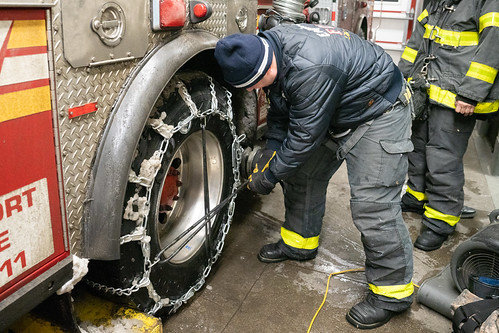
At the same time, the City Council heard testimony that 20 percent of the FDNY's rolling stock is sideline for repairs.
Meanwhile, the fire apparatus industry has fallen prey to private equity firms that have been buying up fire apparatus manufacturers and then doubling the price of ladder trucks to close to $2 million a piece and pumper trucks to over $1 million. At the same time, delivery times have gone from a year to well over four years.
During the catastrophic southern California wildfires over half of Los Angeles's 183 fire trucks were sidelined.
According the New York City’s Motor Fleet report, only 132 ladder units out of the department’s 193 units were in good repair and in service. Out of of 223 FDNY pumpers, just 179 were ready to roll. The sideline rate for FDNY ambulances was even more bleak with city data indicating that out of the 626 ambulances in the city roster, only 469 was available to respond.
Last May, International Association of Firefighters General Chairman Ed Kelly wrote the Antitrust Division of the Department of Justice (“DOJ”) and the Federal Trade Commission (“FTC”) “to investigate and take action against consolidation in fire and emergency vehicle manufacturers” as a consequence of private equity’s buying up of emergency vehicle manufactures.
“We also urge the FTC to use its authority under Section 6(b) of the FTC Act (15 U.S.C. § 46(b))1 to more broadly investigate consolidation trends in that industry as well as other markets for essential emergency vehicles, parts, supplies, and services,” Kelly wrote. “Over the past decade, private equity firms such as American Industrial Partners (AIP) have aggressively consolidated an industry that had been competitively diversified across at least two-dozen companies by rolling up various fire apparatus and emergency vehicle manufacturers into the holding company conglomerate.”
This rapid consolidation and elimination of competition has seriously undermined firefighting readiness across the nation.
“The ongoing persistence of extreme lag times suggests that something other than pandemic supply disruptions caused the backlogs, given that most such disruptions in other industries were resolved far earlier,” Kelly wrote. “Backlogs force fire departments to rely on aging vehicles that are prone to more frequent and more serious breakdowns that require costly repairs.”