Listen Here
What's Going On?
With the deep freeze death toll up to 18, Mayor Mamdani and the city’s civil service worked through the weekend to get shelter challenged New Yorkers indoors.
“Temperatures remain dangerously low, and we are mobilizing every part of the government to keep people safe,” said Mayor Zohran Kwame Mamdani. “As we head into the week, I am urging New Yorkers to stay indoors, take extra precautions, and be safe. If you see anyone outside who needs help, please call 311. Our outreach workers will connect them to warming centers, safe haven sites and shelters.”
In addition to boosting hotel capacity, the city "deployed additional mobile warming units equipped with clinicians and other vital resources and announced new partnerships to strengthen direct street outreach," according to a City Hall press release.
The scramble to get New Yorkers indoors underscored the city's decades long failure to address the chronic homelessness crisis that's got more than 100,000 New Yorkers living in a shelter, with several thousand more living in the shadows.
It's on a scale not seen since the Great Depression.
Over a third of those in shelter are children and over two thirds were families.
According to the New York City Department of Education, 156,000 NYC school children, over ten percent of the student body, experienced homelessness at some point during the prior school year.
From 1996 until 2017, the city lost 1.1 million units of affordable housing amidst a boom in the luxury residential real estate market.
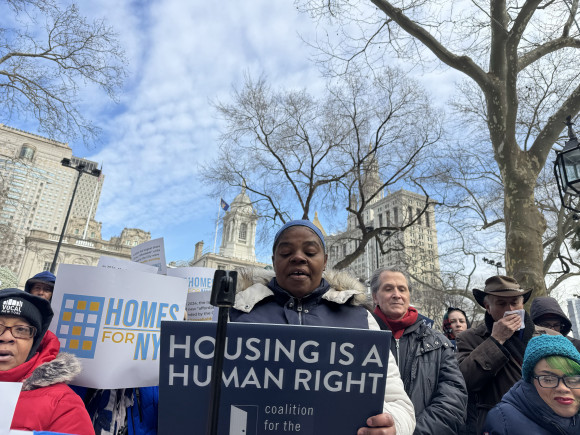
On Friday, with temperatures well below freezing, scores of shelter activists held a press conference in City Hall Park under the Coalition for the Homeless banner.
"Fight, fight, housing is a human right," the crowd chanted before and after every speaker.
"Homelessness leads to illnesses--illnesses lead to death," declared housing activist Cindy Rivera told the crowd. Rivera said that the rhetoric from elected officials about the construction of so-called affordable housing was deceptive because the poorest households are systematically excluded.
"When we heard affordable housing we thought we were going to get housing but what we got is continuously getting sidelined, pushed back--becoming invisible--essentially the city wants low income people to become invisible--but we are not going to disappear. We are here. We are strong because people's power is that power that exists in this world," Rivera said.
Rivera continued. "People are dying and it is serious. Shamefully, in New York City where there are more billionaires in this country living in this city and they are upset because they don't want to get taxed but they are ok with people dying in the street in this cold winter. The system is broken for us but it works for them."
While the recent death toll has made headlines, Alyson Wilkey, director of government affairs for Coalition for the Homeless told WBAI "every winter there are homeless New Yorkers who die and this is just a fact because we have not addressed homelessness in a sufficient way over decades."
Wilkey noted that almost half of the supposed affordable housing units the city has produced was "actually limited to families making six figures so the folks that are the lowest income are the ones living in the shelters and are the ones not eligible because they don't earn enough money."
Wilkey continued. "We have a lot of people living in our shelters who are employed full time--we have city workers living in shelters because they just can't afford housing in the city."
In our second hour, we heard from Debbie White, RN, president HPAE, New Jersey largest nurses union about what's at stake with the New York State Nurses Association strike that will hit the one month mark this week. She was joined by United Steel Workers Nurses Local 4-200 president Jen Kwock and Chief Shop Steward Carol Tanzi who won their 4 month strike back in 2023 against Robert Wood Johnson University Hospital in New Brunswick over safe staffing.